
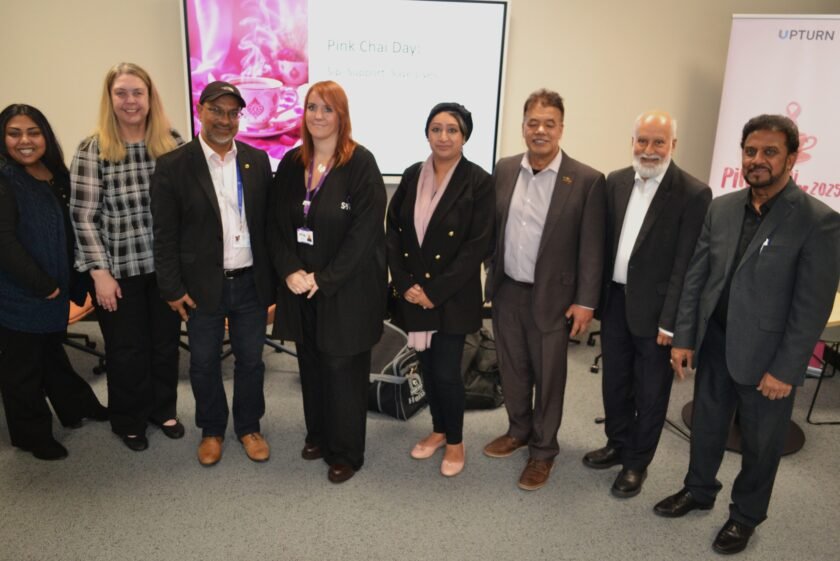
How Community Champion Roles Are Reshaping Routes Back Into Work.
By the Upturn People Team · March 2025
When we talk about the barriers to employment, we often focus on qualifications, experience and skills. But for many of the people Upturn supports, the biggest barrier is not what they don’t know — it is what they no longer believe about themselves.
After years spent caring for family members, managing health conditions, navigating crisis or simply surviving in a system that doesn’t always notice them, many individuals arrive at Upturn with a fundamental loss of confidence in their own worth as workers. They feel out of touch. They feel behind. They feel — as one participant memorably put it — ‘like the world has moved on without me’.
Traditional employment support often responds to this by accelerating people towards job applications — skills training, CV workshops, interview preparation — as if confidence is a prerequisite for the process, rather than something that emerges from it. At Upturn, we believe differently.
What Is a Community Champion?
The Community Champion model emerged from our own experience of what actually works for people who are far from the labour market. A Community Champion is a paid, transitional employment role — typically lasting three to six months — within a community organisation or programme. Champions are employed and supported by Upturn, given real responsibilities and real pay, and embedded in work environments that reflect the communities they come from.
The role is designed to be a bridge — not a destination. It provides the structure of employment, the dignity of a wage, and the daily experience of showing up and doing something that matters — without the full pressure of an unsupported job placement in a competitive market.
Why It Works
The evidence from Upturn’s own delivery is compelling. Participants who complete a Community Champion placement are significantly more likely to move into sustained employment than those who receive employment support without a transitional role. The reasons are not difficult to understand:
- Real work builds real confidence — in a way that training alone cannot replicate.
- Champions develop professional references from within Upturn’s network of employers.
- The supported environment allows mistakes to be learning opportunities rather than crises.
- Champions often discover capabilities and interests they had not previously recognised.
- The social connection of working with others reduces isolation — one of the most significant hidden barriers to employment.
The Evidence
In a recent cohort of Community Champion participants, 87% moved into employment, education or training within 12 months of completing their placement. Many of those who moved directly into employment have remained with the same employer for over a year — a retention rate significantly above the sector average for employment programmes.
Employers who have hired former Community Champions consistently report high motivation, strong work ethic and a deep understanding of their community — qualities that cannot be taught in a classroom.
What This Means for Employment Policy
The Community Champion model has implications beyond Upturn’s own delivery. It suggests that the binary of ‘in work’ and ‘out of work’ is far too crude a framework for understanding the employment support needs of people facing complex barriers. A continuum of supported, paid activity — from transitional roles through to fully independent employment — may offer better outcomes for individuals and better value for funders than the current emphasis on rapid job entry.
We would be delighted to share our learning with commissioners, funders and policy makers who are interested in exploring this approach further.


